

Busy American mornings often leave even the most mindful adults feeling weighed down by stress and racing thoughts. As more people search for gentle ways to steady their mood without psychoactive effects, microdosing CBD is gaining attention as a strategic natural wellness tool. By focusing on minimal, sub-perceptual doses, this approach promises relaxation and balance while sidestepping the disruptions associated with traditional cannabinoid use—offering clarity for those wanting calm, consistent support throughout their day.
Table of Contents
- Microdosing CBD Defined and Debunked
- Types of CBD Microdosing Methods
- How Microdose CBD Works in the Body
- Legal Status of CBD Microdosing in the U.S.
- Wellness Benefits Versus Common Risks
- Microdosing CBD Compared to Alternatives
Key Takeaways
| Point | Details |
|---|---|
| Microdosing CBD | Involves consuming small doses of CBD (2.5-5mg) to achieve beneficial effects without intoxication. |
| CBD Delivery Methods | Popular methods include sublingual tinctures, oral capsules, and vaping, each offering unique absorption rates and duration of effects. |
| Regulatory Landscape | Federal legality allows hemp-derived CBD with less than 0.3% THC; state laws may vary, so consumers should stay informed. |
| Potential Benefits vs. Risks | Microdosing may reduce anxiety and improve clarity, but users must consider product quality and potential drug interactions. |
Microdosing CBD Defined and Debunked
Microdosing is a precise wellness strategy involving consuming extremely small quantities of a substance to achieve subtle health benefits without experiencing significant psychoactive effects. When it comes to CBD, this approach represents a targeted method for integrating cannabinoids into your daily routine with minimal disruption.
Scientifically, microdosing CBD means consuming doses approximately 1/10 to 1/20 of a typical therapeutic amount. Emerging research on microdosing indicates this practice aims to enhance several wellness dimensions:
- Mood regulation
- Stress management
- Cognitive performance
- Overall physiological balance
- Potential anxiety reduction
The core principle of microdosing involves taking cannabinoid quantities so minimal that no intoxicating or disruptive effects occur. Unlike traditional CBD consumption, which might involve larger doses, microdosing focuses on consistent, low-level intake designed to provide subtle therapeutic benefits.
Microdosing represents a nuanced approach to wellness, prioritizing gentle biological interaction over intense physiological intervention.
Researchers have noted several key characteristics of effective CBD microdosing:
- Start with extremely low doses (2.5-5mg)
- Maintain consistent intake schedule
- Monitor personal physiological responses
- Adjust dosage incrementally
- Prioritize quality, lab-tested CBD products
While anecdotal evidence suggests potential benefits, scientific understanding remains evolving. Comprehensive studies on microdosing highlight both promising outcomes and the need for further research to definitively establish long-term effects.
Pro tip: Begin your CBD microdosing journey with professional medical guidance and meticulous self-observation to understand your unique physiological response.
Types of CBD Microdosing Methods
CBD microdosing represents a sophisticated wellness approach that allows individuals to integrate cannabinoids into their daily routine with precision and minimal physiological disruption. Effective microdosing techniques involve carefully selecting consumption methods that optimize absorption and maintain consistent cannabinoid levels throughout the day.
The primary CBD microdosing methods can be categorized into several key delivery systems:
- Sublingual Tinctures: Fastest absorption rate
- Oral Capsules: Precise, consistent dosing
- Edibles: Longer-lasting effects
- Vaping: Rapid onset of effects
- Topical Applications: Localized wellness support
Each method offers unique advantages depending on individual wellness goals and personal preferences. Microdosing techniques emphasize starting with low doses and gradually adjusting to find the optimal personal balance.
Microdosing is about finding your body’s unique cannabinoid sweet spot—not about maximum consumption, but precise, intelligent supplementation.
When exploring microdosing methods, consider these critical factors:
- Individual metabolic differences
- Specific wellness objectives
- Absorption rates of different delivery methods
- Personal comfort and convenience
- Potential interactions with existing health conditions
Sublingual tinctures and oral capsules typically provide the most controlled microdosing experience, allowing users to measure doses with remarkable precision. Vaping offers faster absorption, while edibles provide more extended, gradual effects.
Here’s a concise comparison of common CBD microdosing delivery methods and their distinct attributes:
| Method | Absorption Speed | Dose Control Accuracy | Typical Duration of Effects |
|---|---|---|---|
| Sublingual Tinctures | Very fast | Highly precise | 2-4 hours |
| Oral Capsules | Moderate | Precise | 4-8 hours |
| Edibles | Slow | Moderate | 6-10 hours |
| Vaping | Fastest | Variable | 1-3 hours |
| Topical Applications | Localized (varies) | Difficult to quantify | Depends on product/area |
Pro tip: Start your CBD microdosing journey by consulting with a healthcare professional and maintaining a detailed journal to track your body’s unique response to different consumption methods.
How Microdose CBD Works in the Body
CBD interacts with the human body through an intricate network of biological communication known as the endocannabinoid system (ECS), which plays a crucial role in maintaining internal balance. Cannabinoid interaction mechanisms reveal a sophisticated process of molecular signaling that goes far beyond simple receptor activation.
The primary ways CBD influences bodily functions include:
- Modulating neurotransmitter release
- Reducing inflammatory responses
- Supporting stress adaptation mechanisms
- Enhancing neural plasticity
- Promoting cellular homeostasis
Unlike THC, CBD does not directly bind to cannabinoid receptors. Instead, it works through more nuanced pathways, indirectly supporting the endocannabinoid system by inhibiting enzyme breakdown and enhancing natural cannabinoid signaling.
CBD acts like a gentle biochemical conductor, orchestrating bodily systems toward balanced performance without creating disruptive physiological changes.
The microdosing approach leverages these subtle interactions by introducing minimal cannabinoid quantities that:
- Maintain consistent molecular communication
- Prevent receptor desensitization
- Support gradual systemic adaptation
- Minimize potential side effects
- Promote sustained wellness
Research suggests that small, consistent CBD doses can help regulate various physiological processes, including mood stabilization, pain perception, and immune system responses. The key is finding the precise threshold where therapeutic benefits emerge without overwhelming bodily systems.

Here is a summary of how microdosed CBD interacts with key body systems, compared to traditional dosing:
| Interaction Type | Microdosed CBD Impact | Traditional Dosing Impact |
|---|---|---|
| Neurotransmitter Modulation | Gentle, gradual effect | Strong, rapid effect |
| Inflammatory Response | Supports baseline balance | May produce notable changes |
| Stress Adaptation | Subtle, ongoing support | May cause sedation |
| Neural Plasticity | Maintains consistent signaling | Risk of receptor fatigue |
Pro tip: Track your body’s response meticulously and start with the lowest possible microdose, gradually adjusting based on individual physiological feedback.
Legal Status of CBD Microdosing in the U.S.
Navigating the legal landscape of CBD microdosing requires understanding complex federal and state regulations. Federal CBD regulations establish a foundational framework that allows hemp-derived CBD products containing less than 0.3% THC to be legally accessible nationwide, with important nuanced restrictions.
Key legal considerations for CBD microdosing include:
- Federal legality under 2018 Farm Bill
- State-specific regulatory variations
- FDA oversight of CBD products
- Restrictions on medical claims
- Quality and testing requirements
The legal status varies significantly across different states, with some regions implementing more stringent regulations than federal guidelines. State-by-state CBD laws demonstrate that while hemp-derived CBD is generally permissible, consumers must remain vigilant about local restrictions.
Legal compliance in CBD microdosing is not just about federal permission, but understanding the intricate tapestry of state-level regulations.
Important legal considerations for responsible CBD microdosing include:
- Verify product THC content (must be under 0.3%)
- Purchase from licensed, reputable vendors
- Check local state regulations
- Avoid products making unverified medical claims
- Maintain documentation of product sources
The FDA continues to evaluate CBD’s legal status, with current regulations focusing on preventing unsubstantiated health claims and ensuring product safety. While hemp-derived CBD remains federally legal, consumers must stay informed about evolving legislative landscapes.
Pro tip: Consult local legal resources and keep documentation of your CBD product sources to ensure complete compliance with current regulations.
Wellness Benefits Versus Common Risks
CBD microdosing presents a nuanced approach to wellness, offering potential therapeutic benefits while requiring careful navigation of associated risks. Emerging research on CBD effectiveness suggests promising outcomes for stress reduction and focus enhancement without the sedative effects typical of larger doses.
Potential wellness benefits of CBD microdosing include:
- Reduced anxiety levels
- Enhanced mental clarity
- Improved stress management
- Natural pain modulation
- Subtle mood stabilization
- Support for inflammatory response
However, consumers must remain aware of potential risks. Comprehensive CBD safety research highlights several critical considerations that require careful attention:
- Potential drug interactions
- Possible liver enzyme fluctuations
- Variability in product quality
- Individual metabolic differences
- Unintended side effects
Wellness through CBD microdosing is a delicate balance between potential benefits and responsible consumption.
The most significant risks stem from unregulated product markets, where inconsistent manufacturing standards can lead to unexpected complications. Unlike pharmaceutical interventions, CBD products often lack comprehensive clinical validation, making personal research and professional medical consultation crucial.
Key risk mitigation strategies involve selecting high-quality, third-party tested products, starting with minimal doses, and maintaining consistent medical supervision throughout your wellness journey.
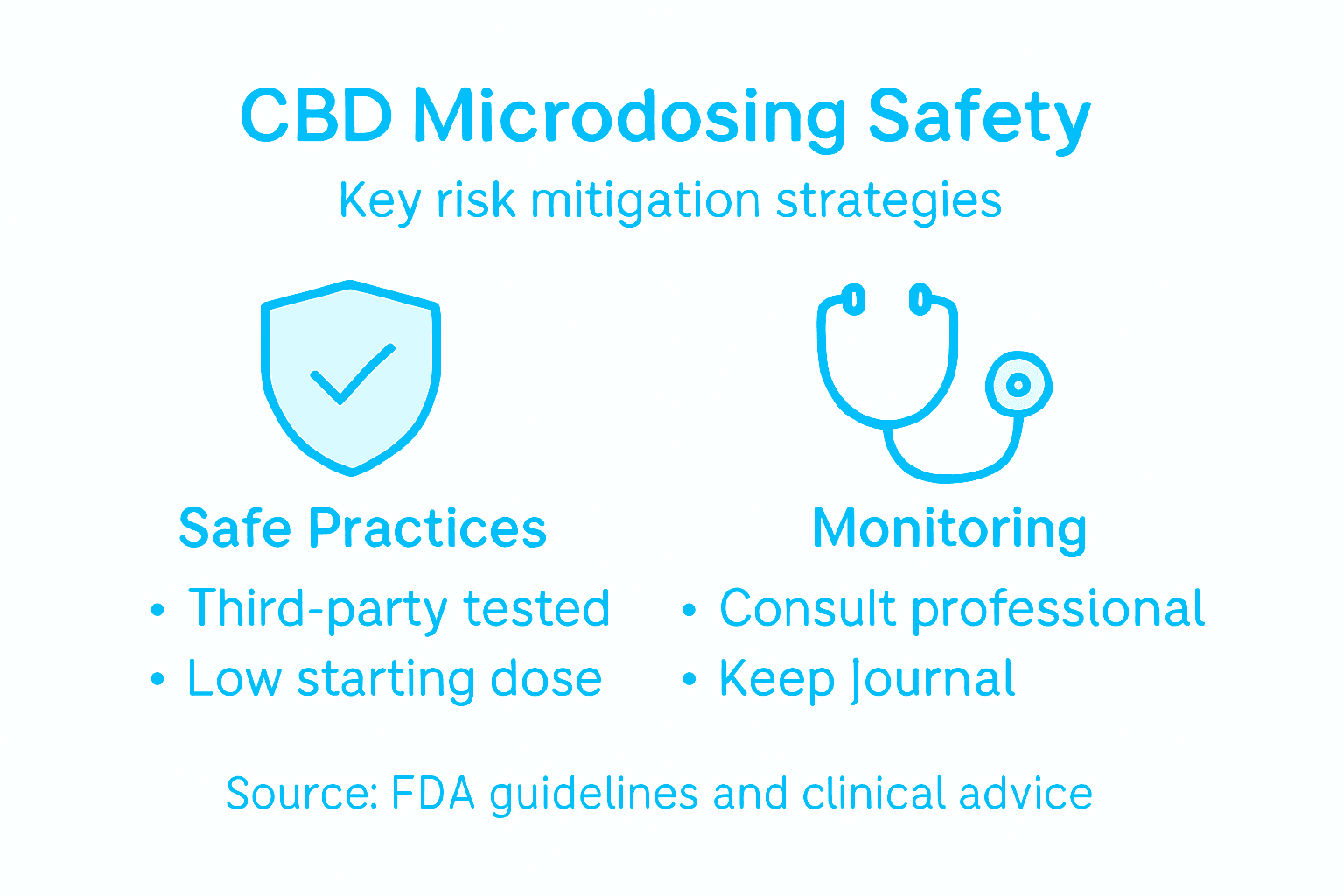
Pro tip: Consult with a healthcare professional and maintain a detailed journal tracking your physiological responses when beginning CBD microdosing.
Microdosing CBD Compared to Alternatives
CBD microdosing offers a nuanced wellness approach distinctly different from traditional pharmaceutical and alternative therapeutic methods. Advanced drug delivery techniques demonstrate how innovative formulations can optimize cannabinoid absorption and effectiveness at significantly lower doses.
Key comparative advantages of CBD microdosing include:
- Non-intoxicating effects
- Minimal side-effect profile
- Subtle physiological modulation
- Consistent molecular interaction
- Reduced dependency risks
- Natural wellness support
Comparative cannabinoid research reveals critical differences between CBD and alternative wellness interventions, highlighting its unique positioning in holistic health strategies:
- Lower psychoactive potential
- More predictable physiological responses
- Broader safety margin
- Less intrusive biological interaction
- Potential for personalized dosing
Microdosing represents a sophisticated approach to wellness, prioritizing precision over intensity.
Unlike traditional pharmaceuticals that often rely on high-dose interventions, CBD microdosing focuses on subtle, consistent biological communication. This approach contrasts sharply with high-THC alternatives, which can produce more pronounced and potentially disruptive effects.
The strategic advantage of CBD microdosing lies in its ability to support wellness without overwhelming the body’s complex physiological systems, making it an attractive option for individuals seeking gentle, natural support.
Pro tip: Document your personal response meticulously and collaborate with healthcare professionals to develop a tailored microdosing strategy.
Discover Wellness Without the THC High with Full Moons Club
The article highlights the benefits of CBD microdosing for subtle wellness improvement without the intoxicating effects of THC. If you are seeking a way to manage stress, enhance relaxation, or support your mental clarity with minimal disruption, the challenge lies in finding a product that delivers consistent low-dose cannabinoids safely and naturally. Full Moons Club understands these needs and offers an innovative solution: premium hemp cigarettes crafted from organic U.S.-grown hemp rich in cannabinoids like CBD, CBG, and CBC with 0% THC for a smooth and gentle experience.

Elevate your daily wellness routine by exploring Full Moons Club, where chemical-free, tobacco-free, and nicotine-free smokes provide a discreet and effective way to enjoy hemp beneficially. With eco-friendly materials and federally legal products, you can embrace healthier, mindful smoking rituals designed to complement your CBD microdosing journey. Start experiencing stress relief and natural calm today by visiting Full Moons Club and discover how subtle cannabinoid support can transform your wellness routine.
Frequently Asked Questions
What is microdosing CBD?
Microdosing CBD involves consuming very small amounts of CBD, typically between 2.5 to 5 mg, to achieve subtle wellness benefits without significant psychoactive effects. This approach helps integrate cannabinoids into your daily routine with minimal disruption.
How does microdosing CBD work in the body?
CBD interacts with the endocannabinoid system (ECS) in the body, modulating neurotransmitter release and supporting various physiological functions. Microdosing allows for consistent molecular communication, preventing receptor desensitization and promoting gradual adaptation to the compound.
What are the primary methods of microdosing CBD?
The main methods of microdosing CBD include sublingual tinctures, oral capsules, edibles, vaping, and topical applications. Each method has unique absorption rates and durations of effects, making it important to choose one that aligns with your wellness goals.
What are the potential risks associated with microdosing CBD?
Potential risks include drug interactions, liver enzyme fluctuations, and variability in product quality. It’s important to select high-quality, third-party tested products and consult with a healthcare professional to mitigate these risks.